Early Life and Troubled Childhood (1960–1977)
Ricardo Leyva Muñoz Ramirez, later known as Richard Ramirez, was born on February 29, 1960. His early life was marked by violence, instability, and neglect. Raised in a strict and abusive household, Ramirez was frequently beaten by his father. During childhood, he suffered a head injury that may have contributed to later behavioral issues.
At the age of ten, Ramirez began using drugs, including marijuana and LSD. His exposure to violence intensified through his cousin, a Vietnam War veteran who often described brutal war crimes in graphic detail. This same cousin later murdered his wife in front of Ramirez when he was 15. Rather than traumatizing him, Ramirez later claimed the event fascinated him.
During adolescence, he developed a deep interest in Satanism and the occult. He often slept in cemeteries to escape his father’s abuse and was sometimes tied to a crucifix as punishment. Around this time, his fantasies began to merge sexual desire with extreme violence, including rape, mutilation, and murder.
Early Criminal Behavior and Escalation (1977–1984)
As a teenager, Ramirez began engaging in petty crime. While still in school, he worked at a Holiday Inn hotel, where he used a master key to rob sleeping guests. His employment ended after he attempted to sexually assault a woman in her room and was caught by her husband.
At age 22, Ramirez moved to California. There, he developed a severe cocaine addiction and began committing burglaries to sustain his habit. These crimes gradually escalated into violent offenses, including assaults, attempted rapes, and murders.
First Confirmed Murder and Emerging Pattern (1984)
Ramirez’s first known murder occurred on April 10, 1984, when he killed nine-year-old Mei Leung in San Francisco. He lured the child into a basement, where he assaulted and murdered her. This crime was not linked to Ramirez until 2009 through DNA evidence. Investigators later suggested a possible second suspect, though no charges were filed.
Later that year, Ramirez murdered a 79-year-old woman in Los Angeles. He brutally attacked and sexually assaulted her body. Although fingerprints were found, technology at the time could not match them to a suspect.
The Night Stalker Crime Spree (1985)
Between April and August 1985, Ramirez carried out a series of home invasions, murders, sexual assaults, and robberies across California. He became known as the “Night Stalker” because he attacked at night, entering homes while victims slept.
His attacks were random and particularly terrifying because victims were chosen arbitrarily. He used a variety of weapons, including guns, knives, hammers, and machetes. Many victims were shot in their sleep, while others were beaten, tortured, or sexually assaulted.
In March 1985, Ramirez began a string of violent attacks. In one case, a victim survived after a bullet ricocheted off her keys. In another, he killed a woman in her home shortly after shooting her roommate. His crimes escalated in brutality, including mutilation and symbolic acts such as carving pentagrams into victims’ bodies.
Throughout the summer of 1985, Ramirez continued attacking multiple households. Victims ranged from children to elderly individuals. He often bound victims, demanded money, and forced them to swear allegiance to Satan. Survivors later provided detailed descriptions of his appearance and behavior.
Despite the violence, some victims survived due to resistance or chance. In one case, a teenage girl survived a severe attack requiring hundreds of stitches. In another, a couple fought back and lived.
Escalation and Public Fear (Mid-1985)
As the attacks continued, fear spread across California. Ramirez showed no consistent pattern in victim selection, making it difficult for law enforcement to predict his next move. His use of satanic imagery and statements further increased public panic.
He left behind clues such as shoe prints from rare sneakers and ballistic evidence linking multiple crime scenes. These patterns allowed investigators to confirm that a single individual was responsible for the series of attacks.
Investigation and Key Breakthroughs (1985)
The investigation was led by detectives who connected evidence across multiple crime scenes. A major breakthrough came when investigators identified the unique shoe prints left behind. Only a few pairs of the specific sneakers existed in the United States, narrowing the search.
However, critical information was leaked during a press conference by Dianne Feinstein, revealing details about the shoe prints and weapons. This allowed Ramirez, who was following media coverage, to destroy evidence by discarding his shoes.
Despite this setback, investigators later discovered a fingerprint inside a stolen vehicle linked to one of the crimes. This fingerprint was matched to Ramirez, who had a prior criminal record. Authorities then publicly released his identity and photograph, warning that he was extremely dangerous.
Identification and Public Recognition (August 1985)
Once Ramirez’s identity was made public, media coverage intensified. His face appeared on newspapers and television across California. Citizens were warned to remain alert and report any sightings.
Ramirez, unaware of how widely his identity had been broadcast, briefly left the state but soon returned to Los Angeles. Upon seeing his face in the media, he panicked and attempted to flee.
Capture by Civilians (August 31, 1985)
Ramirez’s capture was unusual because it was carried out largely by civilians rather than police. After being recognized in public, he attempted to steal a car and escape. Local residents identified him and pursued him through the streets.
A group of citizens eventually overpowered Ramirez, restraining and beating him until police arrived. He was arrested and taken into custody, ending the Night Stalker crime spree.
Trial and Conviction (1988–1989)
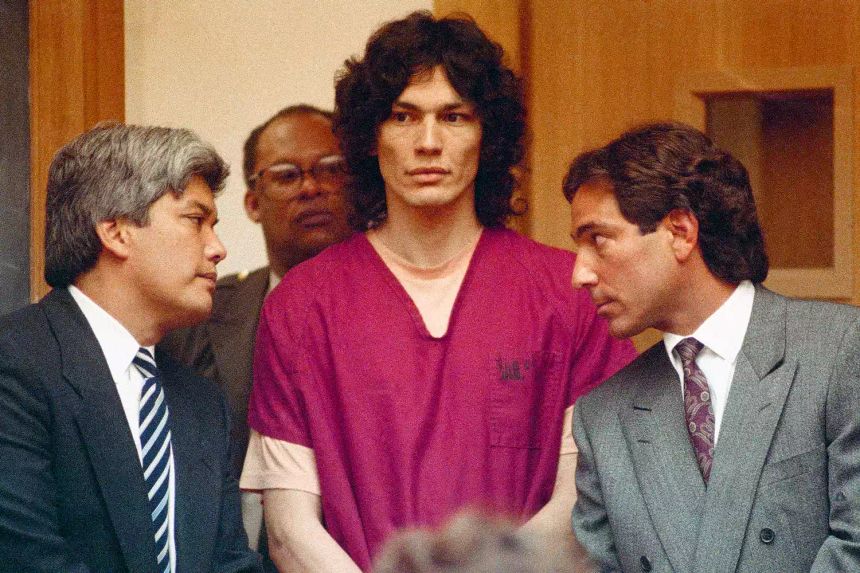
Ramirez’s trial began in 1988 and attracted widespread media attention. During his first court appearance, he raised his hand displaying a pentagram and shouted, “Hail Satan,” reinforcing his image as a remorseless and defiant figure.
The trial faced several disruptions, including the murder of a juror, which initially caused concern about possible connections to Ramirez. However, it was later determined to be unrelated.
In 1989, Ramirez was convicted of numerous charges, including multiple counts of murder, attempted murder, sexual assault, and burglary. He was sentenced to death in California.
Life on Death Row and Marriage (1989–2013)
While awaiting execution, Ramirez became the subject of fascination for some individuals. He received numerous letters from admirers and eventually married one of them, Doreen Lioy, in 1996 while in prison.
Ramirez remained on death row for over two decades as his appeals continued through the legal system. His case remained one of the most notorious in American criminal history.
Death and Legacy (2013)
On June 7, 2013, Richard Ramirez died at the age of 53 due to complications from lymphoma, along with other health issues linked to long-term substance abuse. He died before his execution could be carried out.
His body was unclaimed and ultimately cremated.
Ramirez’s crimes left a lasting impact due to their randomness, brutality, and the fear they caused. His case remains widely studied in criminology as an example of how early trauma, substance abuse, and exposure to violence may contribute to extreme criminal behavior.